Introduction
Spain has a way of getting under your skin. So much history, so much going on, and every region feels like its own country. You could spend a week wandering Toledo or Barcelona, then blow the whole plan and just lie on a Mediterranean beach for three days instead. No shame in that. It's one of Europe's most popular places to visit for a reason. And near the top of anyone's Spain list, if you ask me, sits The Alhambra, the palace complex up in Granada. Moorish architecture, gardens spilling out over the city below, and enough centuries of stories to keep you busy. It's a UNESCO World Heritage Site, and it has been pulling people in for hundreds of years. Here's why it deserves a spot on your itinerary.
Where it is
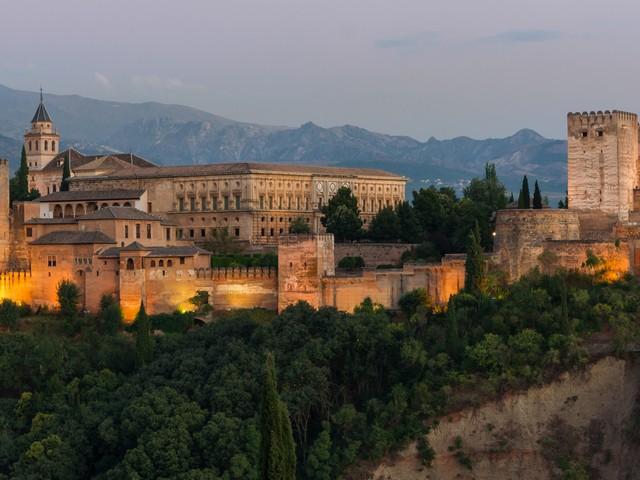
The Alhambra is a Moorish citadel and palace sitting above Granada, in Andalusia, southern Spain. It started life as a fortress back in 889 AD, built on top of an older 9th-century fortification. Then history did its thing. After the Christian Reconquista in 1492, the place became the Royal Court of Ferdinand and Isabella, the Catholic Monarchs, and later served as an imperial palace under Charles V, Holy Roman Emperor. UNESCO added it to the World Heritage list in 1984.
Inside the complex sits the Palace of Charles V. He had it built in 1527, right on the spot where Isabella I of Castile and Ferdinand II of Aragon once kept their summer palace. The building carries his name, though here's the odd part: it went up during his reign as emperor (1519–1556), but he never actually used it as such. He preferred his nearby royal residence at el Escorial.
Why build it at all, then? Politics, mostly. The palace was meant to stand as a symbol of Spanish unity after the Christian victory over Islam at the Siege of Granada in 1492. You can read that intent in the decoration. Most rooms hold portraits or busts of members of the Imperial House and past Spanish monarchs. There's also a big collection of Flemish tapestries, and several murals by Diego Velázquez showing scenes from Charles V's life.
A bit of history
The Moorish rulers of Spain put this place up in the 13th century, and it's still held up as one of the finest examples of Moorish architecture anywhere. It began as a fortress and only later became a palace. Over the centuries plenty of different rulers called it home, the Christian kings of Spain among them. These days it pulls in millions of visitors a year, which makes it one of the busiest attractions in the country.
The architecture
If Spain has architectural treasures, this is near the front of the line. The palace and fortress complex went up in the 13th century under Moorish rulers, then the Christian kings came along and expanded it. It's a UNESCO World Heritage Site now, and one of the most visited places in Spain.
What you're actually walking through is a cluster of palaces, courtyards, gardens and fortifications, all knitted together. Take your time with it. The buildings and grounds are covered in intricate Islamic artwork, the kind of detail you keep noticing new bits of the longer you look. And then there's the setting: views out over Granada and the mountains ringing it. Honestly, that alone is worth the climb.
The Court of the Myrtles
The Court of the Myrtles is one of those spaces that stops you the moment you step in. White walls, blue-and-white tiles, and a long fountain running down the middle. It takes its name from the myrtle trees lining the edges of the courtyard, which are said to stand for paradise. Quiet, still, the kind of place you don't want to talk too loudly in.
The Court of the Lions
Then there's the Court of the Lions, probably the most famous corner of the whole site. The Moors laid it out in the 13th century as a tangle of courtyards, gardens and buildings all folding into one another. The showpiece is the big central fountain, held up by twelve carved lions. Grab a bench, wander the gardens, take your time. Rushing this one would be a waste.
The Hall of the Ambassadors
The Hall of the Ambassadors is where the Alhambra really turns on the grandeur. It's a big, imposing room with a ceiling covered in intricate Moorish designs, and it used to be where the sultans received foreign ambassadors. That sense of ceremony hasn't worn off. Look closely at the carved stucco and the woodwork, then look out the windows at the gardens and mountains beyond. Craftsmanship and view, one after the other.
Final thoughts
The Alhambra pulls Spanish architecture and history together in one place, and if you're anywhere near Granada, go. The stories behind it are as good as the sight of it, which is saying something. You get the views that stay with you for years, and you get a crash course in how these different eras stacked on top of each other, all in one afternoon. I still think about my visit. I'd bet you'll leave feeling much the same.
0 Comments
Leave a Comment