Spain has a way of getting under your skin. There's the history, obviously, and the culture, but also the small stuff: a plate of something you can't pronounce, a plaza at dusk, a beach you didn't plan to stop at. I've lost count of the trips I've taken there. If you're thinking about going this summer and you're not quite sure which cities are worth your time, this post is my attempt to save you some of the guesswork. Here are the places I'd send a friend to, and why. Grab a coffee and start scheming.
Madrid
People come to Spain for all sorts of reasons. The architecture that somehow survived the centuries, the Mediterranean pace of things, the wildly different landscapes, the food, and a culture that runs hot. Madrid, the capital and the biggest city in the country, is where a lot of travellers start, and I think that's the right instinct. You've got the Royal Palace of Madrid, the Prado Museum, Retiro Park, Gran Vía, and Plaza Mayor all within reach. Honestly, give it two or three days minimum. It's the Spain most people have in their heads before they arrive, and it holds up.
Barcelona
Barcelona probably needs no introduction. It sits on the Mediterranean coast, it's the capital of Catalonia, and it's the second largest city in Spain after Madrid. Between the history, the culture and that unmistakable architecture, it's the kind of place you keep meaning to leave and never quite do.
The big three most people chase are the Sagrada Familia, Park Guell and La Rambla. The Sagrada Familia is that world-famous Catholic church Antoni Gaudi designed and, remarkably, they're still building. Park Guell is another Gaudi creation and one of the most visited parks in Europe. La Rambla is the pedestrian street cutting through the centre of the city, lined the whole way with shops, cafes and restaurants, and packed pretty much always.
Don't stop there, though. The Gothic Quarter is a gorgeous tangle of medieval streets and easy to get lost in, which is sort of the point. The Museum of Catalan Art holds a serious collection of Catalan work running from the Middle Ages right up to today. And Montjuic Castle sits up on a hill looking down over the city. It's been a military base, a prison, and now a museum. Quite a résumé for one building.
Granada
Granada, down in Andalusia in the south, is one of those cities that rewards a slower visit. It's stacked with history and culture. The Alhambra is the headline act, a Moorish fortress and palace complex, and I'd book those tickets well ahead because they sell out. Nearby you've got the Generalife, a Moorish garden, and the Albayzín, the old medieval Moorish quarter that's a joy to wander. If you've still got energy, the Cathedral of Granada, the Royal Chapel, and the Real Chancillería de Granada are all sitting right in the centre.
Valencia
Valencia is the third largest city in Spain, after Madrid and Barcelona, and it doesn't get talked about nearly as much as those two. Its loss, your gain. It's on the east coast, the beaches are lovely, the food is excellent and the people are genuinely warm. It's the one I'd send you to for a trip that stays relaxed without leaving you twiddling your thumbs. Start with the City of Arts and Sciences, the Valencia Cathedral, and the Bioparc Valencia Zoo.
Seville
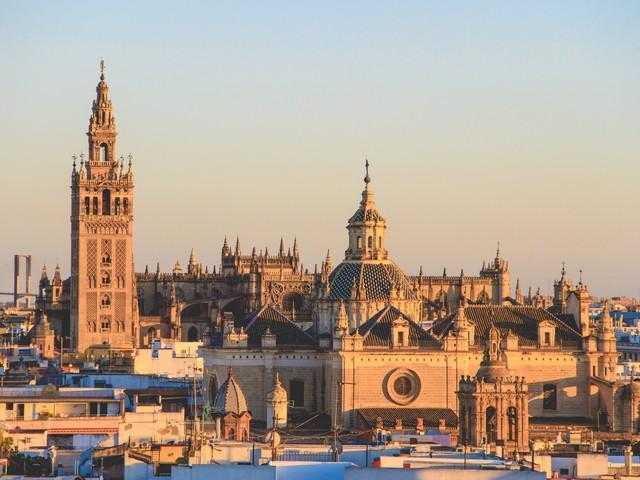
Seville, capital of Andalusia, is a beauty. This is flamenco country, both the music and the dance, and the architecture and the people match the reputation.
You won't run short of things to do. Tour the Alcazar palace, wander the medieval old town until you're pleasantly lost, or take a boat out on the Guadalquivir river. And do sit down for a proper meal somewhere along the streets, a bit of traditional Spanish food and wine at one of the many restaurants and cafes.
Come for the culture, the history, or just a few days off the clock, it all delivers. Don't skip it while you're in Spain.
Bilbao
Bilbao surprised me, to be fair. I expected a gritty industrial city and got a lot more, art and architecture and food and a nightlife that goes late.
The architecture is the first thing that grabs you. Some of Spain's most recognisable buildings are here, chief among them the Guggenheim Museum Bilbao, Frank Gehry's titanium creature by the river. You really do have to see it in person. Beyond that there's the Azkuna Zentroa, a former wine cellar reborn as a cultural centre, the Palacio Euskalduna conference centre and concert hall, and the Iberdrola Tower, one of the tallest buildings in the country.
The art scene backs it up. If that's your thing, the Museo de Bellas Artes de Bilbao is worth an afternoon, and the Guggenheim itself holds a strong collection of contemporary work.
And then there's the food, which no honest write-up of Bilbao can leave out. Basque cuisine is some of the best in Spain, full stop, and good restaurants are everywhere. Order the pintxos, those little bites lined up along the bar, and wash them down with txakoli, the local white.
San Sebastian
San Sebastian is a beach city up in the Basque region, and it might be the prettiest of the lot. The beaches are the draw, but the food does a lot of the heavy lifting too, and the nightlife is lively without being exhausting. Spend your days between the restaurants and cafes, then let the evening take over. There's history here as well, a handful of landmarks and museums, so if Spanish history and culture is what you're after you won't be bored either.
Toledo
Toledo sits in central Spain, roughly 70 km south of Madrid, which makes it an easy day trip if you're short on time. It's the capital of the province of Toledo and of the autonomous community of Castile–La Mancha, with a history reaching back to the Roman Empire. For most of its existence it's been a cultural and artistic hub, and UNESCO named it a World Heritage Site in 1986 for the sheer weight of its monumental and architectural heritage.
They call it "the city of three cultures", shaped over centuries by Christian, Muslim and Jewish influences all at once. The landmarks pile up fast: the Alcázar castle, which you may recognise from Game of Thrones; the Gothic Toledo Cathedral; and El Greco's House Museum. It was also an important stop on the Camino de Santiago pilgrimage route.
Few places give you Spanish culture and history at this volume. Give it a day.
Malaga
Malaga sits right on the Mediterranean in the south of Spain. Beaches, historical sites, a nightlife that keeps going.
A quick tip on timing: go in spring or autumn if you can. The weather is milder then. Summer gets seriously hot, and winter turns cool and wet, so the shoulder seasons are your friend.
There's a lot packed into the city. A few of the ones I'd prioritise:
-The Alcazaba: this 11th-century Moorish fortress is one of the best-preserved in Spain, sitting up on a hilltop over the city.
-The Gibralfaro Castle: a 14th-century castle, also perched on a hilltop, with terrific views over Malaga.
-The Cathedral of Malaga: a 16th-century cathedral and one of the most impressive Gothic buildings in the country, right in the centre.
-The Picasso Museum: dedicated to Pablo Picasso, who was born here, with over 300 of his works on display.
-The Carmen Thyssen Museum: a collection of 19th and 20th century paintings by Spanish artists including Joaquin Sorolla, Ricardo Baroque and Francisco de Goya.
Cordoba
Cordoba was once the capital of Muslim Spain and, believe it or not, one of the largest cities in the world at its peak. Its historic centre is now a UNESCO World Heritage Site. The standout landmark is the Great Mosque of Cordoba, built back in the 8th century, along with the Alcazar de los Reyes Cristianos, a 14th-century castle.
The food is a reason to come in its own right. Cordoba is full of tapas bars and restaurants doing dishes like paella and jamon, the cured ham you'll end up ordering more of than you meant to.
Cordoba is one of those places you leave already planning the next visit.
Wrapping up
Spain gives you a lot to work with. Beaches, cultural landmarks, a bit of adventure, and cities that each have a personality of their own. Madrid, Barcelona, Seville, Bilbao, and all the smaller stops in between, you can build a very different trip depending on what you're after. So maybe start sketching out the next one today. I've never once regretted going back.
0 Comments
Leave a Comment