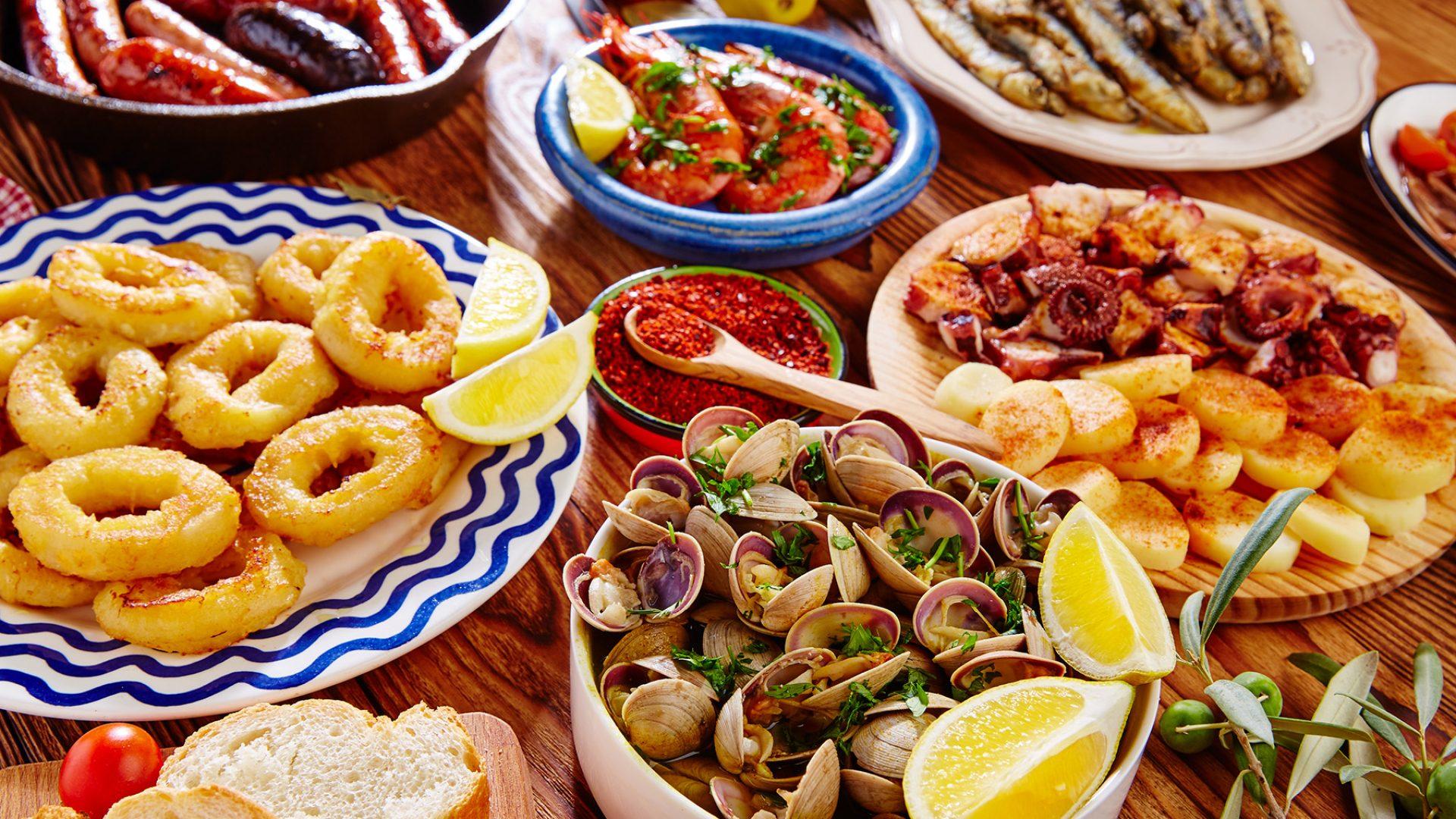
Spain has been serious about food for a very long time. Tapas at the bar, plates that took someone's grandmother a whole afternoon, chefs turning the whole thing on its head in Michelin kitchens — it's a lot to take in. And honestly, that's the problem when you first go: there's too much, and you don't know where to start. So I've pulled together some of the dishes I think you actually need to eat, with a bit on where each one comes from and why it tastes the way it does. Grab a drink. Let's eat our way through the country.
Paella
You knew this one was coming. Paella is about as iconic as Spanish food gets, and it started in Valencia before the rest of the country adopted it. There are endless versions of the rice-and-seafood classic, but the thread running through the traditional ones is saffron, which is what gives the dish that deep yellow colour. It's a main course, and it's meant to be shared straight from the pan. Do not eat paella alone if you can help it.
Gazpacho
Gazpacho is a cold soup made from raw vegetables, and it makes total sense once you've been in Spain in July. When the heat is unbearable, a bowl of something cold and sharp is exactly what you want. The vegetables get chopped small and blended with olive oil, vinegar, water and salt. Some people stir in breadcrumbs to thicken it up.
The usual suspects are tomatoes, cucumbers, red peppers and onions, but this is one of those recipes everyone tweaks. I've had versions with garlic, with green peppers, even with fruit thrown in. You'll see it served as a starter or as a light main, usually finished with croutons or a scatter of diced veg on top.
Jamón ibérico
Jamón ibérico is a cured ham that's native to Spain, and it's a properly special thing. It comes from the hind leg of a pig raised on a diet of acorns and other nuts, then dry-cured for months on end. What you get at the other side is a flavour that's sweet and salty at once — hard to describe until you've had it.
Most of the time it turns up as an appetiser, sliced paper-thin and eaten with bread or crackers. It also finds its way into cooking, like in jamón serrano y queso, the ham-and-cheese pairing that never gets old.
Tortilla española
Tortilla española, or Spanish omelette, is one of those dishes everyone in Spain seems to have an opinion about. On paper it's nothing fancy — eggs, potatoes, onion — but the taste is something else entirely.
You'll find it as a starter or a main, and the handy part is that you can make it ahead and warm it up later. It's the dish to reach for when you're feeding a crowd, because scaling it up is easy. There are variations, of course. Some cooks add peppers or courgette. Cheese isn't part of the classic recipe, but a few people fold it in for extra creaminess. Either way, it's about as easy an entry point into Spanish cooking as you'll find.
Arroz negro
Arroz negro — black rice — is made with squid ink and rice, and it's another one Valencia can claim. Short-grain rice is traditional, though you can use long-grain if that's what you've got. The ink does two things: it turns the rice a dramatic black, and it lends a faintly salty edge to every bite. It looks alarming and tastes wonderful.
Fideua
Think of fideua as paella's noodle cousin. It's a Valencian dish built around short, thin noodles called fideos, usually loaded with seafood — shrimp, squid, lobster. You can make it with chicken or beef too. It's cooked in a paella pan over an open fire, and it comes with aioli, that punchy garlic mayonnaise, served on the side for you to spoon over.
Cocido madrileño
Cocido madrileño is Madrid's own, and it's the kind of food you want when it's grey and cold outside. It's a stew of chickpeas, vegetables and meat, usually with bread on the side to mop up. Hearty doesn't quite cover it — you'll walk away from a bowl of this genuinely full.
Pulpo a la gallega
Pulpo a la gallega comes from Galicia in the northwest, and it's one of the dishes I always order when I'm up that way. Octopus is boiled and then dressed with paprika, olive oil and garlic. It's served on a wooden plate with potatoes, and the story goes that it started with local fishermen cooking their catch over an open fire.
The ingredient list is short, but the flavour is anything but. It's travelled well too — you'll find it right across Spain now, and in plenty of other countries. If you're anywhere near Galicia, order it.
Pimientos de Padrón
Pimientos de Padrón are small green peppers, popular in Galicia and mild in flavour — most of them, anyway. They're fried in olive oil and finished with a good pinch of salt. Simple, moreish, gone in minutes.
They're thought to have come from the town of Padrón, in the province of A Coruña. The peppers first reached Spain from Mexico, brought over by Franciscan monks back in the 16th century, and they've been part of the country's cooking ever since.
These days they're grown all over Spain, though Galicia is still the name most people attach to them. In the last few years they've spread further afield, and you can now spot them in supermarkets in plenty of countries.
Tapas
If there's one thing Spanish food is famous for, it's the sheer range of it — and tapas are the best way to sample a bit of everything. Tapas are small plates, usually served alongside a drink at a bar or restaurant. They come hot or cold, and they often play the role of a pre-dinner appetiser.
There are dozens of them. A few you'll run into again and again:
• Patatas bravas: fried potatoes served with a spicy tomato sauce
• Croquetas: fried balls of dough filled with cheese, ham or fish
• Calamares: fried squid rings that come with a dipping sauce
• Empanadas: baked or fried pastries stuffed with meat, vegetables or seafood
• Tortillas: Spanish omelettes made with potato, onion and egg
Point at whatever looks good on the bar. Odds are you'll want another.
Tortilla de Patatas
Yes, the Spanish omelette again — this time under its other name, tortilla de patatas. Eggs, potatoes, onions. It's a traditional dish that shows up as either a starter or a main.
It's easy enough to make, but don't let that fool you into thinking it's plain. The trick is fresh ingredients and patience — cook the eggs slowly so they stay soft and creamy rather than rubbery.
People have their own methods, but the common route is to fry the potatoes and onions in olive oil until they soften, then pour in the eggs and cook until they set. Once it's done, you slice it into small pieces and serve it warm or cold, whichever you prefer. Good food that won't defeat you in the kitchen — start here.
Churros con Chocolate
Few things say Spanish food quite like churros con chocolate. These fried pastry sticks turn up at breakfast and as a dessert, and they arrive drowning in a thick chocolate sauce. A good churro is crisp outside, soft and fluffy inside, and best of all with a steaming cup of hot chocolate to dunk it in.
Finding them isn't hard. In Madrid, one of the most loved spots is Chocolatería San Ginés, which has been dishing up churros and chocolate since 1894. In Barcelona, head to Xoco for some of the best in town. And down in Seville, the Chocolatería chain La Recova won't let you down. Honestly, it's a hard treat to get wrong anywhere.
One last word
Spain gives you an enormous amount to eat, and this is only scratching the surface. Paella gets all the attention, but there's so much more waiting for you — gazpacho, the slow-cooked comfort of something like Fabada Asturiana, and everything in between. A quick lunch or a long, heavy dinner, it's all there. So next time you land in one of its cities, order the things you can't pronounce and eat well. Your stomach will thank you for it.
0 Comments
Leave a Comment